Veterinary Ownership Transparency
Who Owns Your Vet?
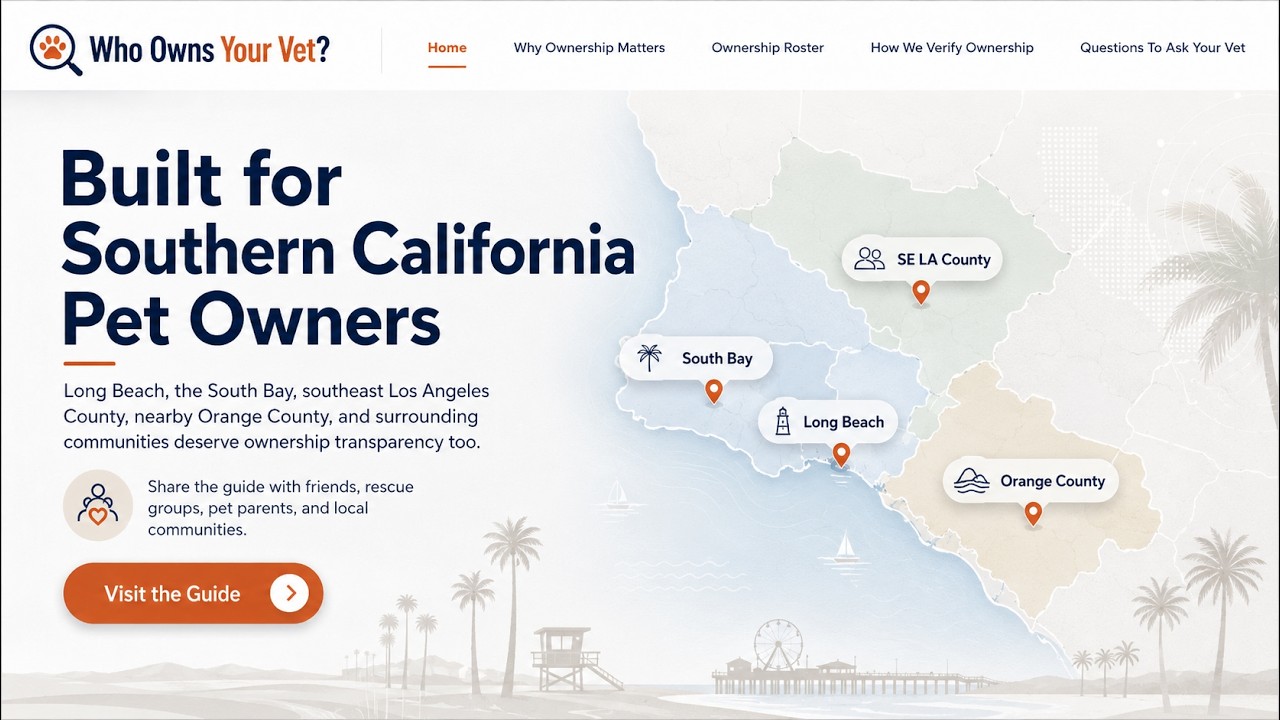
A consumer guide to veterinary ownership transparency in Long Beach, the South Bay, southeast Los Angeles County, and nearby Orange County.
Many veterinary hospitals look local from the outside. Some are independently owned. Others are connected to corporate chains, private-equity-backed platforms, venture-capital-funded companies, retail pet companies, or veterinary support organizations.
This site helps pet owners ask better questions before choosing care.
A hospital can have a neighborhood name, familiar staff, and a local history while still being owned, backed, or managed by a larger organization.
Watch the Explainer
Why pet owners should ask who owns their vet
This short video explains why veterinary ownership transparency matters for pet owners in Southern California.
Watch the 60-second explainer
Learn why local branding does not always mean local ownership.
Why Ownership Matters
Ownership does not automatically determine medical quality.
Excellent veterinarians, technicians, assistants, receptionists, and managers work inside many types of hospitals. This project is not a ranking of medical quality and it is not an attack on hospital teams.
But ownership can shape the business model behind care — including pricing, staffing, appointment length, pharmacy policy, referral pathways, local decision-making, and accountability.
Ask Before You Book
One simple question can change the conversation.
Before you schedule care, ask:
Are you independently owned?
If the answer is unclear, ask who owns the hospital, who manages the business, and whether any corporate, retail, private-equity, venture-capital, or VSO relationship exists.
What to listen for
- Clear ownership disclosure.
- Specific parent company or ownership group names.
- Honest explanation of local versus centralized decision-making.
- Willingness to answer without dodging.
Start Here
Explore the guide
Use these pages to understand ownership, review public signals, ask better questions, and evaluate veterinary jobs with clearer eyes.
Ownership Roster
Review public ownership signals for veterinary hospitals in Long Beach and surrounding areas.
How We Verify Ownership
Learn how public sources, corporate locators, job postings, websites, and correction requests are used.
Submit a Correction
Send documentation if a listing is incorrect, outdated, or incomplete.
For Vet Students & Job Seekers
Review ownership, mentorship, production, staffing, and autonomy questions before accepting a veterinary job.
Workforce Transparency
Veterinary ownership also matters to the people working inside the hospital.
New veterinarians, veterinary technicians, assistants, and hospital teams should understand who owns the workplace they are entering and who controls staffing, scheduling, mentorship, production expectations, medical autonomy, and local decision-making.
View Job Seeker GuideDisclaimer
This site is a consumer-education and workforce-transparency resource. It is not a ranking of medical quality and it is not an attack on veterinarians, technicians, receptionists, assistants, managers, or hospital staff.
Many excellent veterinary professionals work inside corporate-owned, private-equity-backed, venture-backed, retail-owned, and VSO-affiliated hospitals.
The purpose of this project is simple: help pet owners and veterinary job seekers ask better questions about ownership, incentives, and decision-making.